

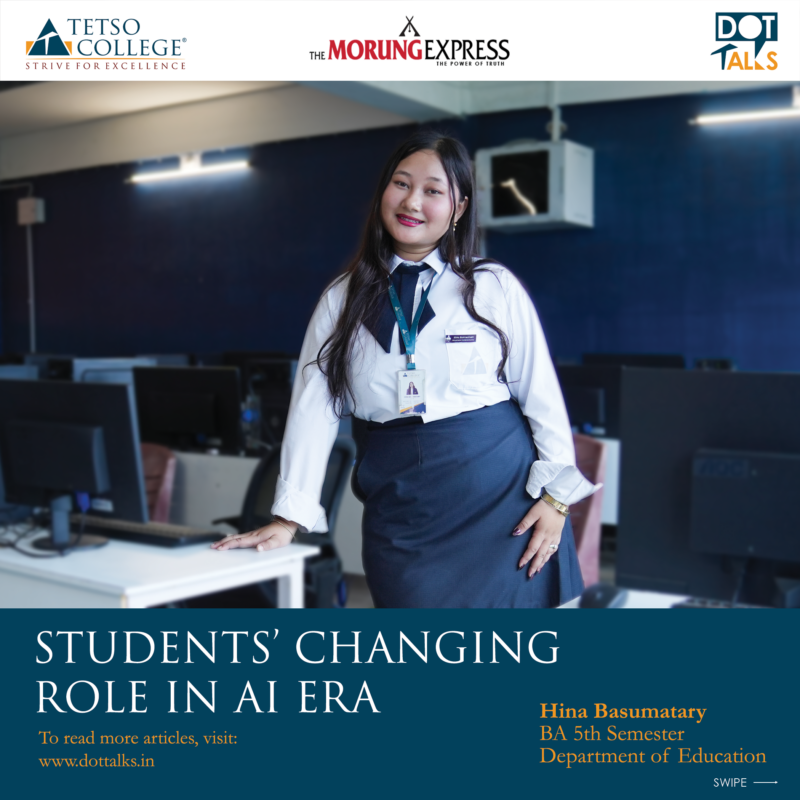
Artificial Intelligence (AI) is rapidly transforming the way we live, work, and learn. In the field of education, its impact is especially visible. Today’s students are no longer limited to textbooks, classroom lectures, and library resources. With AI-powered tools and online learning platforms, information is available within seconds. As a result, students’ roles are changing significantly in this new technological era.
Students today have access to a vast range of educational resources. Whether it is an online course, a tutorial video, an educational website, or an AI tool such as ChatGPT, learning has become more flexible and accessible than ever before. Instead of relying solely on traditional methods, students can now explore topics independently, seek different explanations, and learn at their own pace. Many students experience situations where a classroom lesson is difficult to fully understand. In such cases, online resources often provide alternative explanations that make concepts clearer. Watching educational videos, reading articles, or using AI tools can help bridge learning gaps and strengthen understanding. These resources have become valuable companions to classroom education rather than replacements for it.
Technology has become an inseparable part of modern life. It influences how people communicate, work, and acquire knowledge. In education, technology has made learning more interactive and convenient. Students can attend virtual classes, collaborate on projects, access study materials instantly, and connect with teachers beyond classroom hours. Educational technology has expanded learning opportunities in ways that were unimaginable a few decades ago.
The rise of AI has introduced another important shift. Students are no longer simply receiving information; they are also evaluating, organizing, and applying it. AI tools can answer questions, explain difficult concepts, summarize information, and provide guidance on various topics. This ability to access information quickly can improve learning efficiency and encourage curiosity. One of the greatest advantages of AI in education is personalized learning. Every student learns differently, and AI tools can adapt explanations according to individual needs. A student struggling with a mathematical concept can receive step-by-step guidance, while another student can explore advanced material beyond the classroom syllabus. This flexibility allows learners to progress according to their own pace and level of understanding.
Another significant benefit is immediate feedback. In traditional learning environments, students often have to wait for assignments or exercises to be reviewed. AI tools can provide instant suggestions on writing, grammar, problem-solving methods, and study techniques. Such feedback allows students to identify mistakes quickly and improve their performance more effectively. Teachers can also benefit from these technologies. Preparing lesson plans, quizzes, presentations, and learning materials requires considerable time and effort. AI can assist in generating educational resources, allowing teachers to focus more on meaningful classroom interaction and student engagement.
Despite these benefits, the increasing use of AI also presents certain challenges. One concern is the possibility of overdependence on AI. When students rely too heavily on AI-generated responses, they may miss opportunities to develop independent thinking and problem-solving skills. Learning is not only about obtaining answers but also about understanding the reasoning behind them. Assignments and projects play an important role in developing creativity, research skills, and critical thinking. If students use AI merely to generate completed work without engaging with the content, they risk losing valuable learning experiences. The purpose of education is not simply to produce correct answers but to encourage deeper understanding and intellectual growth.
Another challenge is the reliability of information. While AI systems are powerful, they are not always accurate. They can occasionally provide incomplete, outdated, or incorrect information. Therefore, students must develop the habit of verifying facts through trusted sources and comparing information from multiple references. Digital literacy has become an essential skill in the AI era. Despite these concerns, AI should not be viewed solely through a negative lens.
Like any technological tool, its value depends on how it is used. A calculator can simplify calculations, but students still need to understand mathematical concepts. Similarly, AI can support learning, but it should not replace effort, curiosity, or critical thinking.
The role of students today extends beyond academic achievement. They must learn how to navigate a rapidly changing world shaped by technology and innovation. Online courses, educational platforms, and AI-powered tools offer opportunities to acquire new skills alongside formal education. Students who use these resources wisely can broaden their knowledge and remain competitive in an evolving global environment.
However, the most important qualities for future success remain uniquely human. Creativity, empathy, communication, ethical judgment, and critical thinking cannot be fully replicated by technology. While AI can process large amounts of information, it cannot replace human imagination or emotional understanding. These qualities will continue to distinguish successful learners and future leaders. Students should therefore view AI as a partner in learning rather than a substitute for learning. Responsible use of AI requires awareness, discipline, and a willingness to think independently.
In conclusion, the AI era is reshaping education and redefining the role of students. It has made learning more accessible, personalized, and efficient, creating opportunities that previous generations could hardly imagine. At the same time, students must remain thoughtful and responsible users of these tools. The true purpose of AI in education is not to replace human intelligence but to support it. When used wisely, AI can help students become more informed, capable, and prepared for the challenges of the future. The responsibility ultimately lies with students to use technology as a means of growth, learning, and innovation.