

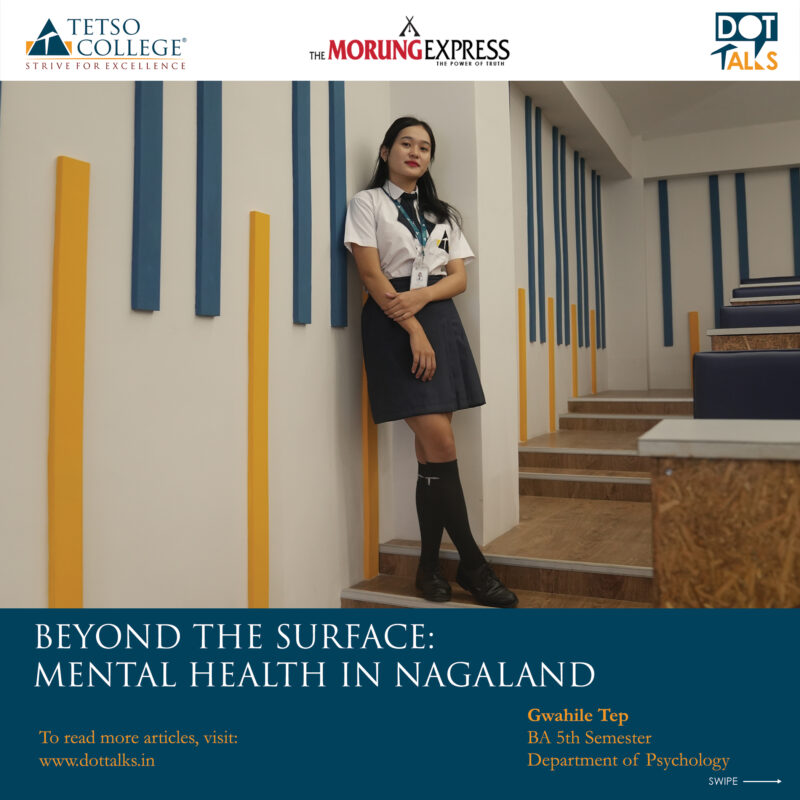
Beyond the Surface: Mental Health in Nagaland
When we bring the conversation about mental health home to Nagaland, what does mental health really mean to us?
In a place where family, community, and faith are important parts of our lives, conversations about mental health are also connected to how we understand strength, weakness, success, failure, and asking for help. We often speak about being strong, adjusting to situations, doing what is expected of us, and moving forward no matter what. These values can help us through difficult times, but they can also make it difficult to admit when we are struggling.
Mental health is still often associated with mental illness, psychiatric hospitals, or the idea that someone is “not normal.” But mental health is much broader than that. It is part of our everyday lives and affects how we handle stress, relationships, expectations, disappointment, grief, change, and uncertainty. The World Health Organization describes mental health as an important part of overall well-being and our ability to cope with the normal stresses of life. Therefore, the conversation should not begin only when someone is already in crisis. It should begin much earlier, with how we understand and respond to one another.
People respond to challenges differently. Some may openly express their emotions, while others may remain quiet and continue with their usual routines. There is no single way to recognise when someone needs support. Changes in behaviour, withdrawal, loss of interest, or simply seeming unlike oneself may sometimes signal that something is wrong. However, these signs should not become reasons for assumptions or labels. What matters is creating an environment where people feel comfortable seeking help when they need it.
This becomes important when we consider how emotional struggles are often treated. If someone has a fever, an injury, or physical pain, we usually have no problem suggesting a visit to the doctor. But when the pain is emotional, the response can be different. A person may hear, “Stop overthinking,” “Be strong,” “Pray more,” “Adjust,” or “Just move on.” Such advice may come from genuine love and concern, and faith, family, and community can provide tremendous comfort and strength. However, there are moments when advice is not what a person needs. Sometimes, having a safe space to speak openly can matter more.
In Nagaland, there is still a need to make professional mental health support feel more normal. Going to a counsellor, psychologist, or psychiatrist should not automatically make someone weak, crazy, or different. It can simply mean recognising that something has become difficult to handle alone. Counselling is not only for people with severe mental disorders. It can also help with stress, grief, relationships, academic pressure, family expectations, confusion about the future, and other challenges.
Psychologist Carl Jung wrote, “Know all the theories, master all the techniques, but as you touch another human soul, just be another human being.” The quote holds particular meaning when discussing mental health. Psychology students learn theories, disorders, assessments, and techniques to understand human behaviour. Yet, behind every diagnosis or assessment is a person with unique experiences and emotions. Mental health care, therefore, requires more than knowledge; it calls for empathy, sensitivity, and respect for the individual.
This is especially relevant in our close-knit communities, where people may know us through our families, churches, schools, colleges, and workplaces. The fear of being judged, misunderstood, or talked about can sometimes make vulnerability difficult. Mental health awareness is therefore not only about recognising disorders; it is also about creating spaces where people can express themselves without being immediately labelled or dismissed.
When discussing mental health in Nagaland, we must also consider the pressures young people face. Education, academic performance, career choices, relationships, family expectations, financial responsibilities, and uncertainty about the future can all affect well-being. One pressure particularly familiar to many young people is the strong aspiration for government jobs.
Government employment can represent stability and financial security, and there is nothing wrong with wanting that. However, the pressure to pursue this path can sometimes come from parents, relatives, or social expectations. After graduation, questions such as “What are you preparing for?” or “When will you get a job?” may seem simple but can weigh heavily on those who have been trying for years. Repeated attempts, comparison with friends, and fear of disappointing family can become exhausting.
The problem begins when a young person feels that their worth depends on getting a government job. This is where honest conversations within families become important. Parents generally want security and a good future for their children, but young people also need space to express what they genuinely want, and no career path should become a measure of their worth.
Nagaland has already taken steps to improve mental health awareness and support. Government initiatives such as Tele-MANAS have helped raise awareness and provide mental-health support, while suicide-prevention and mental-health awareness programmes have also been conducted in schools, colleges, and communities. These efforts are important, but awareness cannot remain limited to campaigns or posters. It needs to become part of everyday life in our homes, classrooms, churches, workplaces, and communities.
We do not have to become therapists to care about mental health. Sometimes, it can begin with something much simpler: listening without judging, asking without pressuring, supporting without comparing, and allowing people to speak without making them feel ashamed of what they are going through.
Maybe mental health awareness in Nagaland needs more than people who know the right terminology. It needs people who understand that care begins with how we treat one another. Mental health is part of everyday life, and a healthier community starts by making it easier to seek help, express themselves, and know they don’t have to face every difficulty alone.